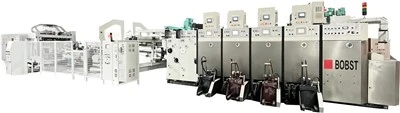

One or more layers of flat "face paper" and wavy "corrugated" paper cores are securely bonded together to create a lightweight, load-bearing board during the continuous and effective process of making corrugated cardboard.

The main steps involved in making corrugated cardboard:
Preparing and heating raw paper: Production starts with a few tons of rolls of raw paper. In order to ensure that the paper has good forming and bonding capabilities, surface paper and corrugated core paper must be heated by preheating rollers to correct humidity and temperature before entering the core equipment.

Corrugated forming and single-sided bonding (single-sided machine): This is one of the most critical steps.
1. Forming: Two interlocking corrugated rollers that are heated to roughly 200 °C are used to push the corrugated core paper into a wavy shape.
2. Gluing: Following formation, the top of the roof will be uniformly covered with a coating of glue (often corn starch adhesive).
3. Composite: Subsequently, the coated corrugated paper and a sheet of surface paper are pressed and firmly adhered under a pressure roller, forming a single-sided corrugated cardboard (two-layer board).
Transporting and buffering: A "bridge" will be used to transport the single-sided corrugated board that the single-sided machine produces to later machinery. This ensures the continuous and stable operation of the entire manufacturing line by automatically adjusting the tension and stacking amount of materials, much like a buffer zone and regulator.
Double-sided bonding and curing (double-sided machine): Core and surface paper must be added to the bridge in order to create standard three-layer or five-layer boards. The single panel's corrugated side will then be glued once more and attached to the inner paper (or another single panel). The adhesive is then completely cured at high temperatures in a lengthy heating and drying section before being cooled and shaped.
Cutting, line pressing, and cross cutting: The two-sided machine creates a wide, continuous piece of cardboard. High-speed cutting tools will cut it as needed:
1. Vertical cutting: Use vertical slitting to cut off burrs in accordance with the final product's width.
2. Indentation: In order to prepare the cardboard for later folding, the crimping wheel will simultaneously press indentation lines on it.
3. Cross cutting: Finally, the rotating cross cutting knife precisely cuts the continuous cardboard into predetermined lengths.
Stacking and quality inspection: A stacking machine neatly stacks the formed corrugated cardboard, which is then either wrapped and stored or sent straight to the next boxing step following a final quality inspection.