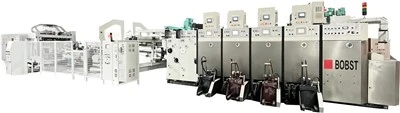

Different measurements can be used to categorize different types of cardboard printing machines. The most important factor is to differentiate according to the printing method (or plate shape), which establishes the machine's technical principles and suitable scenarios.

Cardboard printing machines are generally divided into the following four types:
1. Digital printing machine
Similar to huge printers, computers can print directly without the need to make plates.
Benefits include small batch, customized, changeable data printing, affordable, adaptable and effective, and quick delivery.
Application scenario: Personalized packaging and cardboard boxes printed quickly.
2. Flexographic printing machine
To quantitatively transmit ink via a mesh roller, use flexible rubber or resin plates.
Benefits include great cost-effectiveness, high efficiency, quick mass production speed, and suitability for large-area base color printing.
Use cases include supermarket shelf display boxes and large-scale, standardized corrugated cardboard boxes.
3. Offset Printing Machine
By "printing plate rubber blanket paper" and applying the ink balance principle, images can be transferred indirectly.
Benefits include delicate images, precise color reproduction, exceptionally high printing quality, and the ability to exhibit intricate designs and beautiful photos.
Use cases: Premium paper box packaging includes colorful paper boxes, pre-printed face paper, and boxes for electronics and cosmetics.
4. Other special types
including unique techniques like wire mesh and intaglio printing.
Benefits: Fulfill particular effect specifications, like a thick coating of intaglio ink and a distinctive screen printing texture.
Use cases include particular touch or partial polishing (silk screen printing), high-end tobacco and alcohol packaging (gravure printing), etc.

How to make a quick choice?
Three factors are the primary determinants of machine selection in actual production:
When determining print volume, flexographic printing is recommended for big numbers (long orders); digital printing is recommended for small batches (short orders) or sample creation.
Evaluation of quality: A conventional cardboard box with text, lines, and color blocks as the primary elements is chosen for flexographic printing; high-end packaging with picture quality criteria is chosen for offset printing.
Flexibility: Digital printing is the sole way to make each batch of patterns unique (e.g., printing QR codes on e-commerce express boxes).