

Product Overview
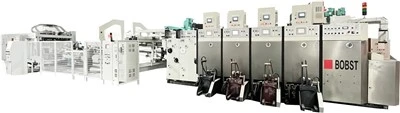
Corrugated box making systems integrate flexographic printing, slotting, rotary die-cutting, and inline folding-gluing into unified production lines. Designed for converting standard and heavy-duty corrugated boards (Flute types: A, B, C, E, AB, BC) into finished shipping cartons and retail packaging.
Target Users: Corrugated box plants, independent packaging converters, and industrial tier-1 suppliers.
Primary Applications: Transport cartons, e-commerce mailer boxes, heavy-duty triple-wall transit packaging, and high-graphics retail shelf-ready displays.
-
![Flexo Printing Press Machine]() Flexo Printing Press MachineThis machine adopts a precision tracking-type set-controlled adjustment, allowing the speed of the rubber pad roller relative to the template roller to be increased or decreased. This achieves
-
![Carton Box Manufacturing Plant]() Carton Box Manufacturing PlantThe compensation principle of the precision setting compensation mechanism is to use an encoder to track the speed of the die-cutting roller, outputting a signal to a variable frequency motor.
-
![Corrugated Box Manufacturing Automatic Plant]() Corrugated Box Manufacturing Automatic PlantFor accurate and stable work, the primary transmission gear is made of premium alloyed steel that has been chamfered and ground.
-
![Carton Box Manufacturing Machine]() Carton Box Manufacturing MachineThe main unit must be started once and the paper feeding portion must go through a reset power-on operation each time the machine is started or following a power interruption caused by an emergency
-
![Automatic Corrugated Box Plant]() Automatic Corrugated Box PlantReplenish when the level falls below the lower limit (new equipment must be replaced within three months, and then annually thereafter).
-
![Corrugated Box Machine Cost]() Corrugated Box Machine CostClean and maintain all moving joints of the partition lifting linkage, especially the graphite sleeves and pins, monthly with diesel fuel or rust remover.
-
![Carton Box Paper Making Machine]() Carton Box Paper Making MachineWipe the machine's moving gears, steel plates, and racks. Wipe with a mixture of diesel and machine oil. Clean the track linings and racks of debris with a scraper.
-
![Small Corrugated Box Making Machine]() Small Corrugated Box Making MachineWipe and clean the surfaces of the pressure roller, grooving cutter roller, and connecting plate roller, as well as the surface of the moving lead screw and the lead screw lubricant. Alternatively,
-
![Flexo Press Printing Equipment]() Flexo Press Printing EquipmentFront-edge feeding, as the name suggests, uses the front edge of the paperboard along the feeding direction for positioning. Its principle is that a strong centrifugal negative pressure suction
-
![Fully Automatic Cardboard Box Printer Machine]() Fully Automatic Cardboard Box Printer MachineThe position of the side baffle on the operating side is from the center line of the cardboard slot to the dimensions of the first label + second label + tongue. (Folding edge side)


Machine Types & Configurations
Modular engineering allows configuration from single-process standalone units to complete inline automated converting systems.
Flexo Printer Slotter Die Cutter (FFSD)
Combines vacuum transfer feeding, multi-color flexographic printing units, servo-driven slotting, and rotary die-cutting in one pass.
Inline Folder Gluer & Stacker (FFG Line)
Extends the FFSD configuration with automatic glue application, square folding, and automated counting/ejection bundling.
High-Speed Rotary Die Cutter (RDC)
Optimized for complex die-cut shapes, inner partitions, and complex display boxes using polyurethane anvil rolls.
Key Specifications
|
Technical Parameter |
Standard FFSD Configuration |
High-End Automated FFG Line |
|
Max. Mechanical Speed |
200 sheets/min |
300 sheets/min |
|
Max. Feeding Size |
900 x 2000 mm to 1600 x 2800 mm |
1200 x 2400 mm to 1600 x 3600 mm |
|
Printing Colors |
1 to 5 Colors |
1 to 7 Colors |
|
Print Registration Accuracy |
±0.15 mm |
±0.10 mm (Full Servo Control) |
|
Cardboard Thickness |
2 to 11 mm (Single to Double Wall) |
1.5 to 13 mm (Single to Triple Wall) |
|
Control Architecture & Electrics |
PLC + Touchscreen HMI (Siemens / Schneider components, CE / UL-compliant control panels available) |
Industrial PC + Multi-Axis Servo Bus (CE / UL-compliant control panels available) |
|
Utility Requirements |
380V/480V, 50/60Hz; Compressed Air: 0.8 MPa, 1.2 m³/min |
380V/480V, 50/60Hz; Compressed Air: 0.8 MPa, 1.8 m³/min |
Material Compatibility
linerboard, testliner, recycled fluting, white-top liner, and heavy-duty corrugated board combinations (B/C/E/AB/BC flute profiles).
Finished Product Types
Regular Slotted Containers (RSC) for logistics and distribution.
Die-cut mailer boxes with locking tabs for e-commerce fulfillment.
Die-cut trays and display boxes for retail environments.

Customization & Production Line Integration
Configuration Options
Modular addition of chambered doctor blade systems, ceramic anilox rollers (line counts from 100 to 300 LPI), vacuum transfer belt brands (Rexroth/Schneider), and automatic pre-feeders.
Plant Integration
Communicates upstream with corrugating lines via production management software (ERP/MES) and downstream with robotic palletizers or strapping units.
Physical Layout & Compliance
Customized based on plant floor dimensions, material flow direction, dust extraction system positioning, and regional safety interlock regulations (CE / OSHA machinery directives).
Quality Control & Manufacturing Capability
Machining & Assembly
Side frames and structural walls are processed on large CNC floor boring and milling machines in a single clamping setup to maintain parallelism within 0.03 mm.
Drive Components
elical transmission gears are carburized, quenched, and precision-ground to grade 6 accuracy, ensuring quiet operation and minimal backlash.
Factory Testing (FAT)
Every machine undergoes a mandatory 72-hour dry run and live board test at 80% rated speed prior to disassembly and export crating.
Documentation
Supplied with complete mechanical assembly drawings, electrical schematics (with recognized global component brands like Siemens/Schneider), PLC backup files, CE or UL compliance documentation, and material inspection reports for critical shafts and gears.
How to Choose & Order
Selection Guidelines
Order Dimensions: Determine maximum and minimum sheet sizes to select the appropriate width model (e.g., 2200mm vs 2800mm).
Daily Output & Job Mix: High-frequency, short-run orders require quick-change pneumatic locking systems and job-memory storage; high-volume runs prioritize top mechanical speed.
Process Requirements: Select between standalone printing/slotting or full inline folding-gluing depending on downstream finishing capacity.
Plant Constraints: Verify ceiling height, total line length, power supply capacity, and compressed air volume against the utility specification table.
Procurement Workflow
Technical Consultation: Submit box style samples, target materials, and production targets for engineering review.
Proposal & Layout: Receive formal quotation, utility requirements drawing, and factory layout blueprint.
Contract & Deposit: Finalize technical protocol, electrical standards (CE/UL), payment terms, and production schedule.
Manufacturing & FAT: In-person or virtual Factory Acceptance Testing.
Shipping & Commissioning: Ocean freight delivery followed by on-site mechanical installation, calibration, and operator training by certified service engineers.
FAQ

Request a Quote
To receive a detailed technical and commercial proposal tailored to your plant requirements, please provide the following details:
Max and min carton sizes (Unfolded layout dimensions)
Board types and flute profiles processed
Required printing color count
Target daily output and shift duration
Destination port or plant location (including electrical power standard)
We're well-known as one of the leading printing press machinery manufacturers and suppliers in China. Please feel free to buy cheap printing press machinery for sale here from our factory. Quality products and low price are available.
Popular Products