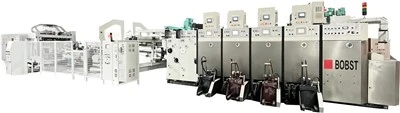

Printing machinery is primarily categorized into five types: lithographic, letterpress, gravure, screen, and digital printing machines.
Lithographic presses (offset presses) are the most widely used, accounting for approximately 70% of the global printing market share. They offer a printing resolution of over 2400 dpi and a per-sheet printing cost of about 0.01 RMB (for A4 paper), making them ideal for mass production items such as books and packaging boxes; however, their plate-making cycle is relatively long. Letterpress presses (flexographic presses) can reach speeds of up to 300 meters per minute and support a variety of materials-including plastic films and corrugated cardboard-while utilizing eco-friendly water-based inks; however, they tend to exhibit weaker tonal gradation in images. Gravure presses are primarily employed for high-end packaging and banknote printing; their printing plates boast exceptional durability, capable of enduring millions of impressions, though the associated plate-making costs are relatively high (ranging from 5,000 to 20,000 RMB per set). Screen printing machines are suitable for printing on irregular surfaces, such as glass and textiles, with prices ranging from 2,000 to 500,000 RMB. Digital printing machines require no plate-making and are well-suited for personalized printing tasks, offering speeds of up to 4,600 sheets per hour at a cost of approximately 0.5 RMB per A4 sheet. When selecting a printing machine, it is essential to comprehensively evaluate factors such as production volume, material requirements, and budget constraints.