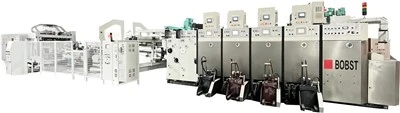

Modern printing presses typically consist of mechanisms for plate mounting, inking, impression, and paper feeding. During operation, the text and images to be printed are first converted into a printing plate, which is then mounted onto the press. Subsequently-either manually or via the machine-ink is applied to the specific areas of the plate containing the text and images. This inked image is then transferred, either directly or indirectly, onto paper or another substrate, thereby reproducing a printed product identical to the original plate.
The art of printing was first invented in China; printed books began appearing in China as early as the 9th century, and the printing technology invented there subsequently spread to nations across the globe. The invention and evolution of the printing press have played a pivotal role in the dissemination of human civilization and culture.
In 1439, Johannes Gutenberg of Germany constructed a wooden relief printing press. Although this vertical screw-type hand-operated press featured a simple design, it remained in use for 300 years. In 1812, Friedrich Koenig of Germany built the first cylinder-and-flatbed relief printing press. In 1847, Richard Hoe of the United States invented the rotary printing press. By 1900, a six-color rotary press had been developed, and in 1904, Ira Rubel of the United States invented the offset printing press.
Prior to the 1950s, traditional relief printing processes dominated the printing industry, and the development of printing presses focused primarily on relief presses. However, lead-alloy relief printing suffered from several drawbacks: high labor intensity, long production cycles, and environmental pollution. Beginning in the 1960s, offset lithography-characterized by shorter production cycles and higher productivity-began to emerge and flourish, gradually displacing lead-alloy relief printing. Other printing methods-such as flexography, screen printing, electrostatic printing, and inkjet printing-also saw significant development, particularly in the fields of packaging and advertising.
Printing presses are classified according to the form of their printing plate into four categories: relief, lithographic (offset), intaglio (gravure), and screen presses. Based on their plate-mounting and impression mechanisms, they are further categorized into flatbed-to-flatbed, cylinder-to-flatbed, and cylinder-to-cylinder presses.